Bolivia Adds Rules for Virtual Assets
Bolivia expands its crypto framework under the IMF, adds ASFI oversight, and defines virtual asset service providers in Decree 5384.
Bolivia has defined, through Supreme Decree 5384, a framework that recognizes blockchain, tokenized assets and virtual assets, and requires virtual asset service providers to incorporate and obtain authorization under ASFI supervision. At the same time, the government is keeping its commitment to the IMF to build a robust crypto oversight regime, and the FIU has expanded requirements for auditors and accountants.
Update September 20, 2026: Bolivia added Supreme Decree No. 5384, which recognizes blockchain-based solutions, tokenized assets and virtual assets, and places Virtual Asset Service Providers under the supervision of ASFI. The FIU also clarified how professionals covered by Administrative Resolution No. 075-2026 must verify whether they are reporting entities.
Bolivia told the International Monetary Fund it would build a robust regulatory and supervisory framework for cryptocurrencies and virtual assets, aiming to reduce the risk of illicit capital outflows and strengthen financial resilience. The new framework now joins Supreme Decree No. 5384, which expressly recognizes those technologies and requires PSAVs to incorporate and obtain authorization under ASFI supervision.
What did Bolivia request in the IMF deal?
Bolivia agreed to develop a robust framework to regulate and supervise virtual assets, according to IMF-linked documents and reports from specialized media. The commitment appears in an economic and financial policy memorandum submitted to the fund, although it has not yet been specified whether the framework will come through a law, a supreme decree or administrative rules.
The wording reported by crypto.news and Odaily points to a specific goal, preventing the use of crypto assets from facilitating capital outflows outside traditional channels. However, the materials reviewed do not set an implementation timeline or identify the authority that will formally be in charge.
Later coverage also places that commitment within a 36-month expanded program under an Extended Fund Facility for 13.69 million special drawing rights, equivalent to about $1.9 billion, still pending approval by Bolivia's Congress and the IMF Executive Board.
What changes with Supreme Decree No. 5384?
Supreme Decree No. 5384 explicitly recognizes blockchain-based solutions, tokenized assets, virtual assets and the figure of Virtual Asset Service Providers, or PSAVs. The rule says these companies must be incorporated and obtain operating authorization under the corresponding regime, under ASFI supervision.
According to the regulatory development cited by Carlos Maiz, the PSAV definition is broad. It includes exchange between virtual assets and fiat currencies, exchange between different virtual assets, transfers, custody and certain financial services linked to the offer or sale of virtual assets.
That scope places platforms and technology operators inside a much clearer regulatory perimeter than the one that existed when the government was only speaking about a future framework. It also matches international coverage describing Bolivia's shift as an explicit reversal of its earlier general ban on cryptocurrencies.
What role would ASFI have in that framework?
The Financial System Supervisory Authority, ASFI, was mentioned by a Bolivian vice minister of economic affairs as a central actor for financial supervision within the IMF agreement. Morales said the agency "will play a fundamental role" in evaluating and monitoring the financial system.
That signal reinforces the idea that the control architecture would not be concentrated in a single political office, but would rely on existing financial regulators. Supervision of PSAVs under Supreme Decree No. 5384 also confirms that ASFI already has an operational foothold in the matter.
In September 2026, ASFI also ordered financial intermediation entities that overcharged customers in dollar sales to return, within 15 administrative business days, the difference between the official exchange rate and the parallel rate. The measure included a requirement to proactively contact affected customers and allowed a second-level complaint before ASFI itself.
How is the crypto market moving in Bolivia?
Various surveys describe a financial system increasingly exposed to digital assets, especially for cross-border payments and remittances. A regional analysis says that after the general ban on crypto assets was lifted in 2024, about $14.8 billion in crypto transactions were recorded in the following 12 months, driven by dollar shortages and the need for payment alternatives.
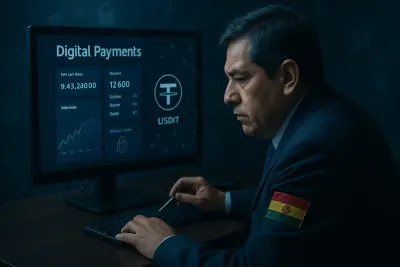
The same report says that by April 2026, Banco Unión, through its Yasta wallet, and Banco FIE, through its mobile app, were already offering USDT purchases and sales. The operation was aimed at international payments and remittances, while the Ministry of Economy was considering recognizing USDT as a payment instrument circulating alongside the boliviano and the dollar, subject to anti-money laundering safeguards.
In the same vein, The Rio Times said the Central Bank of Bolivia registered significant growth in the use of digital assets for cross-border payments since 2024, and highlighted Banco BISA as one of the most active institutions in that segment.
What changes for the FIU and reporting entities?
Bolivia's Financial Investigations Unit has already been expanding reporting obligations for designated nonfinancial activities and professions, known as DNFBPs. Administrative Resolution No. 075-2026 requires certain auditors and accountants to identify, analyze and report suspicious transactions through the CARONTE V2 platform.
La Razón and a legal analysis by Rojas Law Firm agree that the scope is not automatic for the entire sector. The obligation mainly targets those who provide services to Large Taxpayers or who are involved in real estate activities, asset management, corporate structuring and large-scale audits. For other professionals, reporting status must be checked by NIT on the FIU's official portal.
Later practical guidance clarified that lawyers, accountants and other DNFBPs must actively verify on the FIU website whether their NIT, or that of the professional firm, appears in the "Universe Delimitation" of reporting entities. That step determines whether they must operate with CARONTE V2 and reinforces the technology and registry component of the regime.
That framework already positions the FIU as an operational actor in local financial supervision, alongside the eventual virtual asset regime that Bolivia says it will implement as part of the reforms agreed with the IMF.
Sources
- Criptomonedas en Bolivia – Carlos Maizcarlosmaiz.com· Carlos Maiz (blog jurídico, citando normativa boliviana)
- Bolivia Pledges to Establish a Virtual Asset Regulatory Framework to Prevent Capital Outflows Through Crypto Marketsodaily.news· Odaily
- Stablecoin Regulation in Latin America: Brazil, Mexico, ...stablecoininsider.org· Stablecoin Insider
- La UIF deja de esperar: el registro de abogados, contadores e ...rojas-lawfirm.com· Rojas Law Firm
- Cámara de Diputados de Bolivia aprueba el acuerdo con el FMI por 1.900 millones de dólaresabc.com.py· ABC Color
- Bolivia to tighten crypto oversight as part of IMF backed reformscrypto.news· crypto.news
- Auditores y/o contadores como agentes de información ante la UIF: la encrucijada entre el deber legal y la confianza del clientelarazon.bo· La RazónUnverified URL
- Morales: ASFI jugará un rol fundamental en supervisión financiera por acuerdo con FMIeju.tv· eju.tv
- Auditores y/o contadores como agentes de información ante la UIF: la encrucijada entre el deber legal y la confianza del clientelarazon.bo· La Razón
- Bolivia commits to establishing a cryptocurrency regulatory framework.techflowpost.com· TechFlow (citando Criptonoticias)
- Opening a Bank Account in Bolivia as a Foreigner - The Rio Timesriotimesonline.com· The Rio Times
- Devolución de cobros elevados será en 15 díaslaprensa.bo· La Prensa (Bolivia)
- The International Monetary Fund pushes Bolivia towards tightening oversight on cryptocurrenciesarabictrader.com· Arabic TraderUnverified URL
- Bolivia Commits To Crypto Oversight Under IMF Program Amid USDT Adoptiononebullex.com· OneBullex
- Auditores y/o contadores como agentes de información ante la UIF: la encrucijada entre el deber legal y la confianza del clienteinforse.com.bo· InfoRSE
- Bolivia to tighten crypto oversight as part of IMF backed reformscryptonews.net· Cryptonews
- Bolivia Commits to Crypto Regulation Under $1.9B IMF Programphemex.com· Phemex
- Morales: ASFI será clave en supervisión financiera por acuerdo con FMIlarazon.bo· La Razón (Bolivia)
- 玻利维亚向IMF承诺建立虚拟资产监管框架,防资本经加密资产市场不当外流panewslab.com· PANews