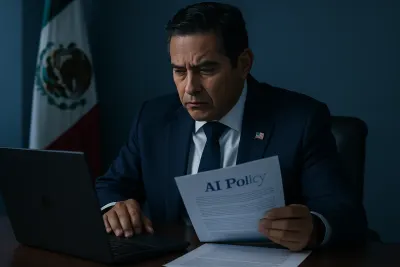
Mexico speeds legal framework for AI rules
Morena is pushing a broad AI framework in Mexico as the Senate and the executive branch advance data reforms.
Morena has set the creation and approval of a comprehensive legal framework to regulate artificial intelligence in Mexico as one of its priorities for the next ordinary legislative session. The agenda includes user privacy, cybersecurity, human rights, the ethical use of personal data and support for innovation.
Update September 24, 2026: Mexico's AI debate gained new legislative fronts and more technical context. The Senate received a proposal to authorize Congress to issue a general law, while another presidential initiative seeks to regulate AI uses in industrial property with new penalties and powers for IMPI.
Morena has made the creation and approval of a comprehensive legal framework to regulate the use of artificial intelligence in Mexico one of its priorities for the next ordinary legislative session. The agenda covers user privacy, cybersecurity, human rights, the ethical use of personal data and support for innovation.
The caucus plans to have draft committee reports ready during the parliamentary recess, with the goal of speeding up review and an eventual floor vote once the ordinary session opens on September 1. According to XEU, the legislative path aligns with the agenda promoted by President Claudia Sheinbaum and seeks to sync the congressional debate with the federal executive branch's view of the technology.
XEU also notes that Mexico currently lacks a comprehensive, AI-specific regulatory framework, a gap backers of the initiative cite as part of the urgency to move forward with a legal structure on the issue.
What changed in Congress on AI?
The Senate received a constitutional reform proposal in February 2026 to expressly empower Congress to issue a General Artificial Intelligence Law. In April, the Senate's general bill had not yet been scheduled, according to El Economista.
According to that report, the starting point is constitutional: without that reform, Congress would not have an express mandate to enact a general law on the matter. The debate adds to the path already being pushed by Morena and other factions in the Chamber of Deputies.
How far would the proposed regulation go?
According to an analysis published by El Universal, the Mexican proposal is partly inspired by the European AI rulebook. Its provisions include banning discriminatory biometric categorization systems, subliminal techniques used to manipulate vulnerable groups and state social-scoring algorithms.
The same analysis says the project classifies algorithms used in employment, credit scoring, health resource allocation and criminal justice as high-risk systems. For those cases, it calls for strict audits, traceability of training data and human oversight.
The initiative also includes controlled testing environments, or regulatory sandboxes, to reduce the risk of slowing technological innovation and to help new models and applications develop under supervision. It also calls for stronger transparency requirements on data sources and tough penalties for realistic identity impersonations, including denigrating deepfakes.
What other projects are already on the table?
The AI debate is not limited to Morena's proposal. Mexico's presidency sent the Senate a bill to amend 217 articles, add 23 and repeal 6 of the Federal Law for the Protection of Industrial Property, with the goal of regulating artificial intelligence uses in that area for the first time.
ECIJA's coverage says the project also includes administrative sanctions and new powers for the IMPI. In parallel, the federal government announced that, once the World Cup is over, it will open a national debate on regulating artificial intelligence and digital platforms with participation from Congress, specialists and civil society.
What do specialists say about the starting point?
Mexico scored 0.25 points on the OECD open data index, below the 0.53 average, according to an El Economista report cited in the latest tracking of the issue. In that same note, Jesús Eulises González Mejía counted 13 federal laws and regulations that mention artificial intelligence.
In the Chamber of Deputies, AI regulation appears on the legislative agenda alongside other controversial proposals, which shows the issue remains on the Congress's path. In that same vein, the PT introduced a proposal to explicitly include artificial intelligence in the General Education Law, with rules on personal data protection, transparency and system explainability, without creating a separate subject or setting a specific grade level.
The PRI also announced a separate bill to criminally punish the use of AI for identity theft, fraud and extortion, in a move that is hardening the debate over criminal uses of this technology in Mexico.
Sources
- Regular la inteligencia artificial: un primer paso en propiedad industrial, muchos pendientes por delanteecija.com· ECIJA
- Morena busca regular la Inteligencia Artificial; ¿qué contempla la ley?xeu.mx· XEU Noticias
- El laberinto constitucional de la regulación de la IA en Méxicoeluniversal.com.mx· El Universal
- Regulación de redes sociales y de IA: Estos son los temas primordiales para Morena en el Congresoelfinanciero.com.mx· El Financiero
- PT propone incluir inteligencia artificial en los planes de estudio de México con reglas para proteger datos y orientar su uso en clases y evaluacioneselimparcial.com· El Imparcial
- Entre la regulación de la IA y la ley mordaza, una agenda polémica divide a San Lázarodebate.com.mx· El DebateUnverified URL
- México prepara ley de inteligencia artificial sin una visión de Estado: especialistaseleconomista.com.mx· El Economista
- México regula la inteligencia artificial por sectores ...eleconomista.com.mx· El Economista
- Ley de IA avanza en México mientras enfrenta el reto de invertir en tecnología propiainfobae.com· Infobae
- Artificial Intelligence 2026 - Mexicopracticeguides.chambers.com· Chambers and Partners
- Queda sin fecha presentación de ley de inteligencia artificial en el Senadoeleconomista.com.mx· El Economista
- Mientras el Senado presenta una ley de IA, la ciberseguridad sigue sin avanzarexpansion.mx· Expansión