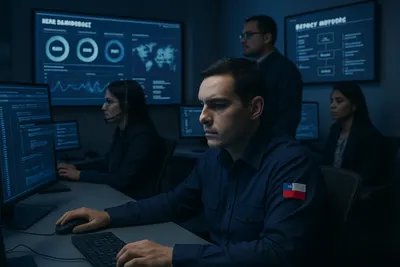
Chile boosts its response to financial fraud
Chile’s CMF reported five entities for alleged fraud as authorities launched new anti-fraud coordination and moved on stablecoin rules.
Chile’s Financial Market Commission filed a complaint with prosecutors against five entities that were offering loans through websites, apps and WhatsApp after detecting signs of fraud aimed at people seeking financing in Chile. The move came alongside a new public-private response to transnational financial fraud, an intersectoral agreement signed by Chilean authorities, and a Central Bank consultation on a new stablecoin framework.
Chile’s Financial Market Commission filed a complaint with prosecutors against five entities that were offering loans through websites, apps and WhatsApp after detecting signs of fraud targeting people seeking financing in Chile. The filing came at the same time Chile launched a national task force against transnational financial fraud, signed an intersectoral agreement among authorities, and moved ahead with a Central Bank decision to consult on a new stablecoin framework.
What prompted the CMF complaint?
The CMF acted after detecting signs of fraud in loan offers distributed through digital channels, according to the agency and independent local coverage. The case involved five entities that drew in potential victims through websites, apps and WhatsApp, a scheme that was reported to prosecutors.
Diario Estrategia published the warning as a public alert about the multiple digital channels used to reach victims, while the CMF formalized the complaint over alleged fraud offenses. The starting point was the offer of financing to people looking for credit in Chile.
What new coordination did Chile activate against fraud?
Chile’s Public Prosecutor’s Office and public and private entities created the National Task Force Against Transnational Financial Fraud to coordinate prevention and prosecution through information sharing and interagency cooperation. The group includes the ANCI, CMF, SII, SERNAC, UAF, BancoEstado, ABIF, ARF and NIC Chile.
According to Chócale, the task force will also enable a platform run by the Public Prosecutor’s Office to share statistics, trends, criminal patterns and aggregated data on financial fraud. In parallel, SERNAC said it signed an agreement to establish a strategic framework for intersectoral cooperation and coordination aimed at preventing, detecting and effectively prosecuting financial fraud in Chile.
What changes for financial and crypto regulation?
Chile’s Central Bank said it will open a consultation on a new regulatory framework for stablecoins, with conditions for issuance in Chile when they can be used as a means of payment. The bank added that the Fintech Law gave it authority to regulate their issuance and operation as a means of payment under its payment systems and financial stability mandate.
That move rests on a regulatory perimeter created by Law 21.521, in force since January 2023, for the fintech ecosystem and implemented by the CMF during 2023 and 2024 with governance, transparency and anti-money laundering requirements for issuers and platforms registered as virtual asset service providers, according to Unknown Gravity.
How does this connect with cybersecurity and digital fraud?
FinteChile said that under Chile’s open finance system, all participants will have to meet the same security standards, which means uniform cybersecurity obligations for banks, fintech firms and other regulated financial actors. In that context, the Central Bank reported that unknown or customer-reported fraudulent banking transactions reached US$98 million in the first half of 2026, up 26% year over year.
That figure was released by the Central Bank itself amid wider use of electronic payment methods. The combination of fraud complaints, public-private coordination and new stablecoin rules shows how Chile is tightening financial compliance around digital risks that are already embedded in the system.
Sources
- CMF denuncia a cinco entidades por estafamsn.com· MSN / Comisión para el Mercado Financiero (CMF)
- Presidente de FinteChile: “La Tasa Máxima Convencional genera una distorsión de mercado per se y es antiintuitiva”fintechile.org· FinteChile
- Entidades públicas y privadas crean mesa contra el fraude financiero transnacionalchocale.cl· Chócale
- CMF alerta y denuncia por presuntos delitos de estafa a entidades que ofrecen créditos en sitios webdiarioestrategia.cl· Diario Estrategia
- Postergar la Ley de Datos Personales: un síntoma, no una solucióntrendtic.cl· TrendTIC
- Ciberseguro en Chile: Guía para Empresas ante la Ley 21.719exigetuseguro.cl· Exígete Seguro
- Autoridades firman convenio que permitirá constituir una mesa nacional contra el fraude financiero transnacionalsernac.cl· SERNAC
- Presentación del Informe de Sistemas de Pago 2026 - Banco Central de Chileyoutube.com· Banco Central de Chile
- Tokenización de activos en Chile: Ley Fintech y CMFunknowngravity.com· Unknown Gravity
- Informe de Sistemas de Pagobcentral.cl· Banco Central de Chile
- Chile: Ley de Protección de Datos e Inteligencia Artificial, el doble desafío que enfrentan las empresascompliancelatam.legal· Compliance Latam