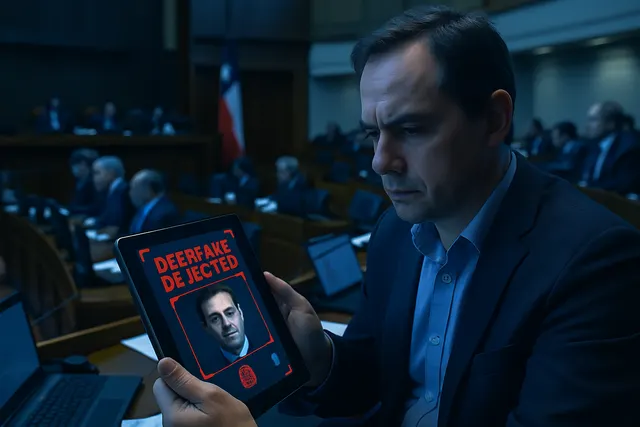
Chile approves anti-deepfake bill
Chile's lower house backed a bill regulating AI deepfakes, with platform obligations, sanctions and legal actions still under review.
Chile’s Chamber of Deputies approved, by 128 votes in favor, 2 against and 5 abstentions, the bill that regulates the creation and spread of realistic digital imitations of a person’s image, body or voice generated with artificial intelligence. The proposal has returned to committee and remains under legislative review.
What the Chamber approved
Chile’s Chamber of Deputies gave general approval, in the bill’s first constitutional stage, to a measure that regulates the creation and dissemination of realistic digital likenesses of people’s image, body, or voice generated through artificial intelligence. The vote ended with 128 in favor, 2 against, and 5 abstentions.
After that initial approval, the initiative went back to the Chamber’s Committee on Future, Science, Technology, Knowledge and Innovation for an article-by-article vote, so the text is still moving through the legislative process.
Scope of the bill
The bill has 12 permanent articles and one transitional provision. Its stated aim is to protect people’s digital identity and integrity against content created or altered with AI that simulates their image, body, or voice.
According to the legislative material cited by the sources, the rule would apply to both individuals and legal entities, as well as social media platforms offering services in Chilean territory.
The proposal provides for legal action against those who fail to comply, including liability for damages and precautionary measures. Those measures include removal of the content at the request of the affected person and other steps intended to stop the harm when there is an imminent risk of irreparable damage.
Platform duties and penalties
If approved in its current form, social media platforms would have to appoint a legal representative with a domicile in Chile, set up a reporting channel, and use visible labels for content generated or modified with AI.
The text would also give sanctioning powers to the future Personal Data Protection Agency. According to the source, which has not yet been officially confirmed in its final scope, that authority could impose fines ranging from 5,000 to 10,000 UTM on legal entities and individuals. That part will depend on final approval of the text and any eventual implementing rules.
A broader regulatory package
The advance of the deepfake bill comes alongside another digital measure already approved by Chile’s Chamber of Deputies. That is bill No. 14,767-03, which seeks to strengthen copyright protection in the digital environment.
That text introduces a legal definition of technological protection measures, known as TPM, and establishes liability for circumventing them. It also contemplates criminal liability for commercial circumvention and for the manufacture, distribution, or provision of devices and services designed to facilitate it. The bill was sent to the Senate, and the Committee on Economy began reviewing it on July 21, 2026, with no firm voting schedule.
Regulatory pressure in the region
Garrigues’ July 2026 data economy and cybersecurity newsletter places sector regulators, business associations in technology and financial services, and the ministries of Justice and Science and Technology among the main drivers of regulatory modernization in data protection and cybersecurity in Chile and Brazil. The report also highlights pressure from major digital platforms and banks to clarify implementation timelines and sanctioning criteria.
In Mendoza, Argentina, the provincial Senate began formal debate on a Cybersecurity Law proposal backed by the executive branch, aimed at protecting public and private information systems, setting protocols for attacks, and improving incident response. In parallel, legislators from Fuerza Patria introduced a cybercrime proposal focused on personal data protection and limited to the provincial and municipal public sector. That bill requires each state agency to appoint, within a maximum of 180 days after a possible approval, a professional responsible for data protection.
Regulation of AI avatars and deepfakes in Chile and Latam
Chile has given general approval to a bill that regulates the creation and dissemination of realistic digital likenesses made with artificial intelligence. The measure is still moving through the process and must still be voted on article by article.
The text applies to individuals, legal entities, and social media platforms operating in Chilean territory. It also requires that AI-generated or AI-modified content be identified and provides for sanctions, content removal, and legal action for damages.
The move comes amid growing regulatory pressure in the region, with Chile and Brazil seeing momentum from supervisory agencies, ministries, and private sector actors to define implementation timelines and sanctioning criteria.
Sources
- PL 2338/2023 – Dispõe sobre o uso da Inteligência Artificialwww25.senado.leg.br· Senado Federal do Brasil
- DPL News Spotlight Política Digital #3dplnews.com· DPL News
- Proyecto de ley para proteger la identidad digital de las personas despierta consenso, pero enfrenta retosdf.cl· Diario Financiero
- Ley de Protección de Datos e inteligencia artificial: desafíos para las empresas en Chilelexlatin.com· LexLatin
- Ciberseguridad de los organismos del Estado e infraestructura crítica de la información (Ley 21.663)bcn.cl· Biblioteca del Congreso Nacional de Chile
- Chile advances bill to strengthen protection of digital copyrightintellectual-property-helpdesk.ec.europa.eu· European Innovation Council and SMEs Executive Agency
- PL 4752/2025 – Institui o Marco Legal da Cibersegurançawww25.senado.leg.br· Senado Federal do Brasil
- Radiografía de la regulación digital en América Latina: desafíos y avances hacia la modernizacióntecknow.news· Tecknow News
- Nuevas normas de protección de niños en internet en Colombia: ¿servirán?eltiempo.com· El Tiempo
- Multas Ley 21.719: Hasta 20.000 UTM ($1.400 Millones)cercai.cl· Cercai
- Cumplimiento de Apps en LatAm: Guía ISV para 5 Paísesnexforce.ai· Nexforce
- Delitos informáticosbcn.cl· Biblioteca del Congreso Nacional de Chile
- Newsletter de Economía del Dato, Privacidad y Ciberseguridad - Julio de 2026garrigues.com· Garrigues
- Resultados de búsqueda para “ Ley de Servicios Digitales”dplnews.com· DPL News
- Ley de Ciberseguridad en Mendoza avanza en el Senadoepelbyte.com.ar· Epelbyte
- Ley 21.663 de Ciberseguridad en Chile: A Quién Obligacercai.cl· Cercai
- AWS: La armonización regulatoria es clave para mantener el liderazgo de Chile en IAdplnews.com· DPL News
- Mientras se debate la Ley de Ciberseguridad, el kirchnerismo presentó su propio proyecto contra el ciberdelitolosandes.com.ar· Los Andes