Buenos Aires school deepfakes prompt probe
Students in Lomas de Zamora were accused of sharing AI-made sexual images of classmates. Investigators are tracking how far the material spread.
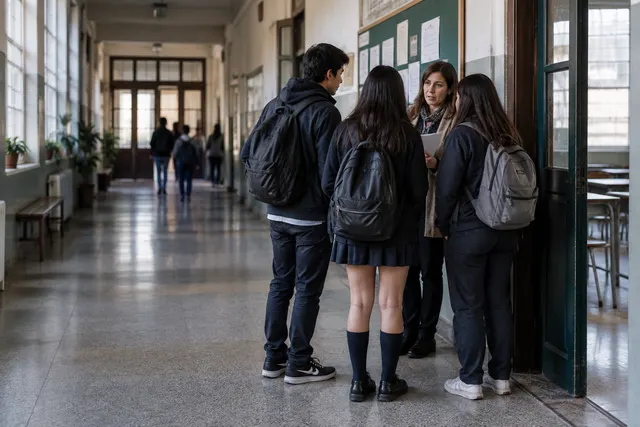
At a school in Lomas de Zamora, Buenos Aires province, students were accused of spreading sexually explicit images created with artificial intelligence of their classmates. C5N said more than 50 female students may have been affected, while other coverage placed the case around at least 40 minors and reported charges, searches, and phone seizures as investigators trace how the material spread.
At a school in Lomas de Zamora, in Buenos Aires province, students were accused of spreading sexually explicit images created with artificial intelligence of their classmates. C5N reported that more than 50 female students may have been affected. Other coverage said prosecutors are investigating both the creation and circulation of deepfakes built from real photos of minors.
What was reported at the school?
The complaint centers on the creation and spread of fake sexual content made with AI from real photos of female students. According to Infobae, citing EFE, families took the case to court over sexual deepfakes made with images of at least 40 minors at a school on the outskirts of Buenos Aires.
That same report said two 15-year-old teenagers were charged, and the investigation remained open to determine whether other students were involved and how widely the material spread. La Voz added that the content may also have circulated among students at other schools and on adult sites, although that point was attributed to that outlet.
What steps did the court take?
Authorities seized phones and searched homes as part of the case, according to the reports available. Perfil said the homes of four third-year students were searched, and that the action was authorized by the Juvenile Guarantees Court No. 3 in Lomas de Zamora.
La Voz also said phones were seized from two charged teenagers to reconstruct how the content was created, shared, and possibly sold. Diario Popular reported that the fake images and videos may have been organized into catalogs with real data from about 45 teenage girls and offered through WhatsApp groups and digital platforms.
How large was the case?
The reported scope varied across coverage, but all accounts pointed to a large number of potential victims and circulation beyond the school. C5N said more than 50 female students were affected, while Infobae, citing EFE, said at least 40 minors. Perfil placed the investigation around images of roughly 50 classmates from different grades.
Those varying figures suggest the case is still developing, and investigators are still trying to determine how many students took part, how the sharing was organized, and whether the material was sold. In parallel, Chequeado published a guide on what to do if a daughter or son is a victim of an AI-generated sexual deepfake, as this kind of harm is already appearing in schools.
How does it connect to other scams and digital monitoring?
The case sits alongside a regional landscape of more industrialized digital fraud and a state framework that expands automated monitoring of open sources. iProUP reported, citing a Group-IB investigation, that Argentina accounted for 14.3% of Latin American operations tracked in a Classiscam sample.
According to that coverage, Classiscam uses Telegram bots to generate fraudulent pages and lets operators choose the service to impersonate and the currency used in the operation. Group-IB also identified domains prepared to impersonate services used in Argentina, including Mercado Libre and Mercado Pago.
The same investigation cited by iProUP described CallFlow as a phone fraud tool under development that combines a language model, voice recognition, and synthetic voice. Separately, El País reported that Resolution 428/2024 from the Ministry of Security authorizes systematic monitoring of open sources and the use of automated technologies to analyze online information, and that Decree 383/2025 added cyber-patrolling as a power of the Federal Police without judicial authorization when open sources are involved.
Sources
- La estafa en un colegio de Lomas de Zamora: denunciaron a alumnos por difundir fotos sexuales de sus compañeras creadas con IAc5n.com· C5N
- Crece el negocio de los videos sexuales falsos de alumnas hechos con IAdiariopopular.com.ar· Diario Popular
- Habló la mamá de una de las víctimas de las fotos creadas con IA: “Publicaron datos reales de las chicas”lavoz.com.ar· La Voz
- Escándalo en Argentina por la difusión de deepfakes sexuales de menores en una escuelainfobae.com· Infobae, cobertura de EFE
- Qué es el crimen como servicio y cómo opera en Argentinaiproup.com· iProUP
- Qué hacer si tu hija o hijo es víctima de un deepfake sexual creado con IAchequeado.com· Chequeado
- Desnudos con IA: allanaron las casas de cuatro alumnos en Lomas y se investiga otro casoperfil.com· Perfil
- La vigilancia y el control digital se expanden en América Latina al margen de los signos políticoselpais.com· El PaísUnverified URL